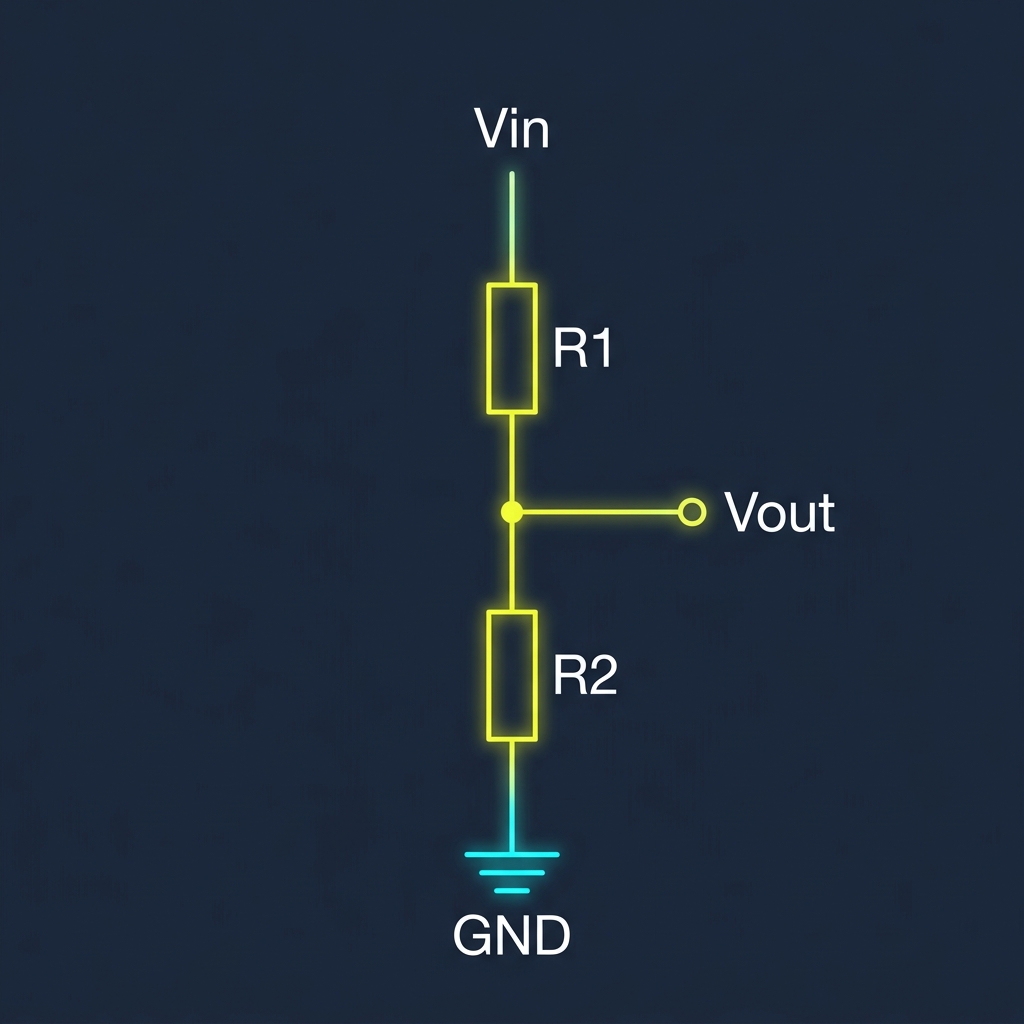
Find Output Voltage
Output Voltage (Vout)
Vout = Vin × [ R2 / (R1 + R2) ]
The Theory Behind Voltage Dividers
A voltage divider is one of the most fundamental and universally used passive linear circuits in electronics engineering. Its primary purpose is to produce an output voltage (Vout) that is a specific fraction of its input voltage (Vin). This is achieved by distributing the input voltage among the components of the divider—typically two resistors connected in series.
The mathematical relationship is defined by Ohm's law and Kirchhoff's voltage law. The formula used by our calculator is: Vout = Vin * (R2 / (R1 + R2)). This simple equation forms the backbone of countless applications, from sensor signal conditioning and level shifting (like connecting a 5V sensor to a 3.3V microcontroller) to setting reference voltages in analog circuitry.
Why Use Standard E-Series Resistors?
While mathematical formulas can yield highly precise, non-integer resistance requirements, real-world manufacturing relies on standardized values. The E-series is an internationally standardized system of preferred values for electronic components. The E12 series offers 12 values per decade (10% tolerance), the E24 series offers 24 values (5% tolerance), and the E96 series offers 96 values (1% tolerance) for high-precision analog design.
Our Voltage Divider Planner intelligently searches through these standardized arrays to find the real-world resistor pairing that will get you as close to your target output voltage as physically possible, minimizing your design time and reducing part-sourcing headaches.