Understanding Low-Side MOSFET Switching
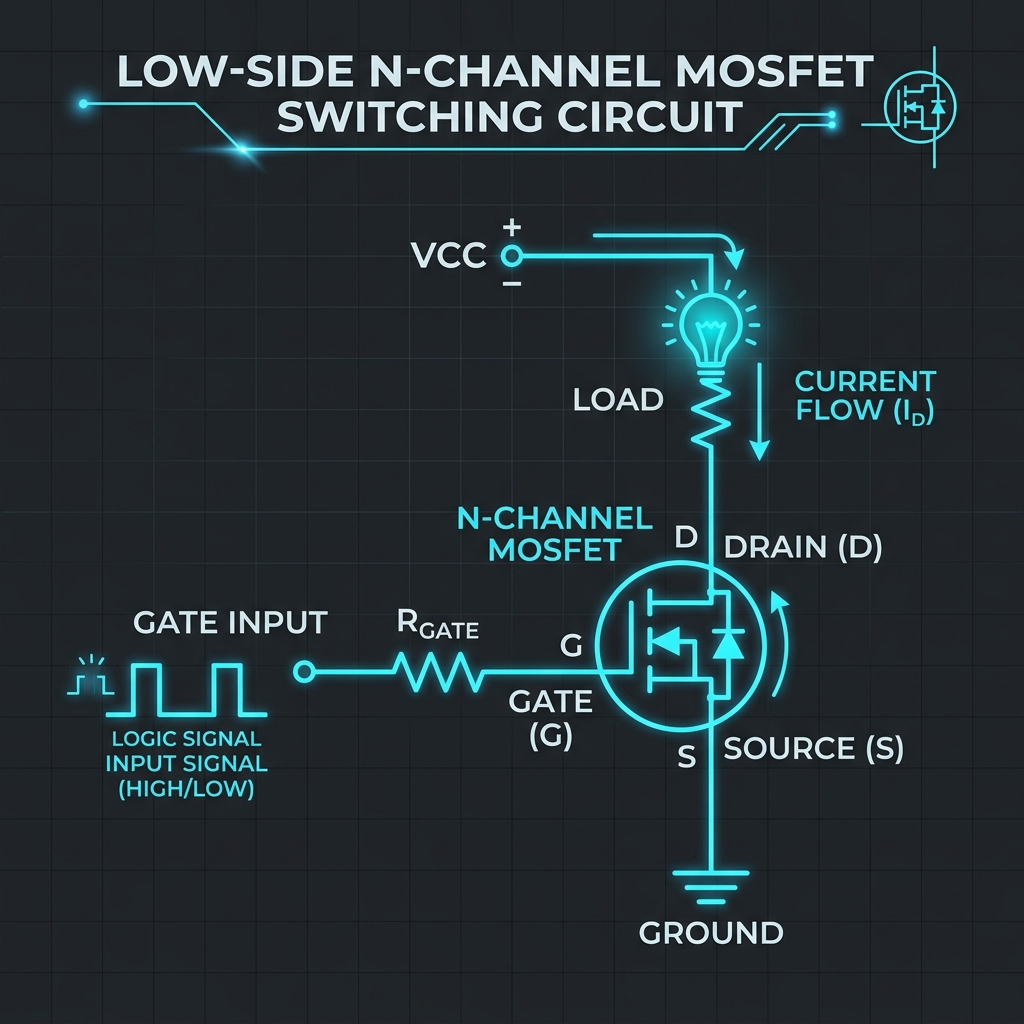
What is a Low-Side Switch?
A low-side switch is placed between the load and Ground (0V). In this configuration, the load is permanently connected to the positive supply (Vcc), and the switch completes the circuit by providing a path to ground. This is the most common and simplest method of switching in hobbyist electronics and many embedded systems.
Using an N-Channel MOSFET
For low-side switching, an N-Channel MOSFET is the standard choice. Its Source is tied to Ground, and its Drain connects to the load. To turn the MOSFET ON, the Gate voltage is pulled higher than the Source (Vgs > 0). To turn it OFF, the Gate is pulled down to Ground (Vgs = 0).
Because the Source is firmly tied to ground, driving an N-Channel MOSFET from a microcontroller is very straightforward. As long as you choose a "Logic-Level" MOSFET (one that fully turns on at 3.3V or 5V Vgs), you can connect the Gate directly to an MCU pin (usually with a small series resistor to limit switching current and a pull-down resistor to prevent floating).
Pros and Cons
- Pro: Extremely easy to drive directly from low-voltage logic circuits (microcontrollers).
- Pro: N-Channel MOSFETs are generally cheaper, smaller, and have lower RDS(on) than P-Channel equivalents.
- Con: The load is always "hot" (connected to Vcc). If the load wiring shorts to a grounded chassis, it will turn permanently ON, which can be dangerous.
- Con: You lose a common ground reference for the load, which can interfere with communication protocols if the load is a smart device.