The Versatile 555 Timer: Astable and Monostable Modes Explained
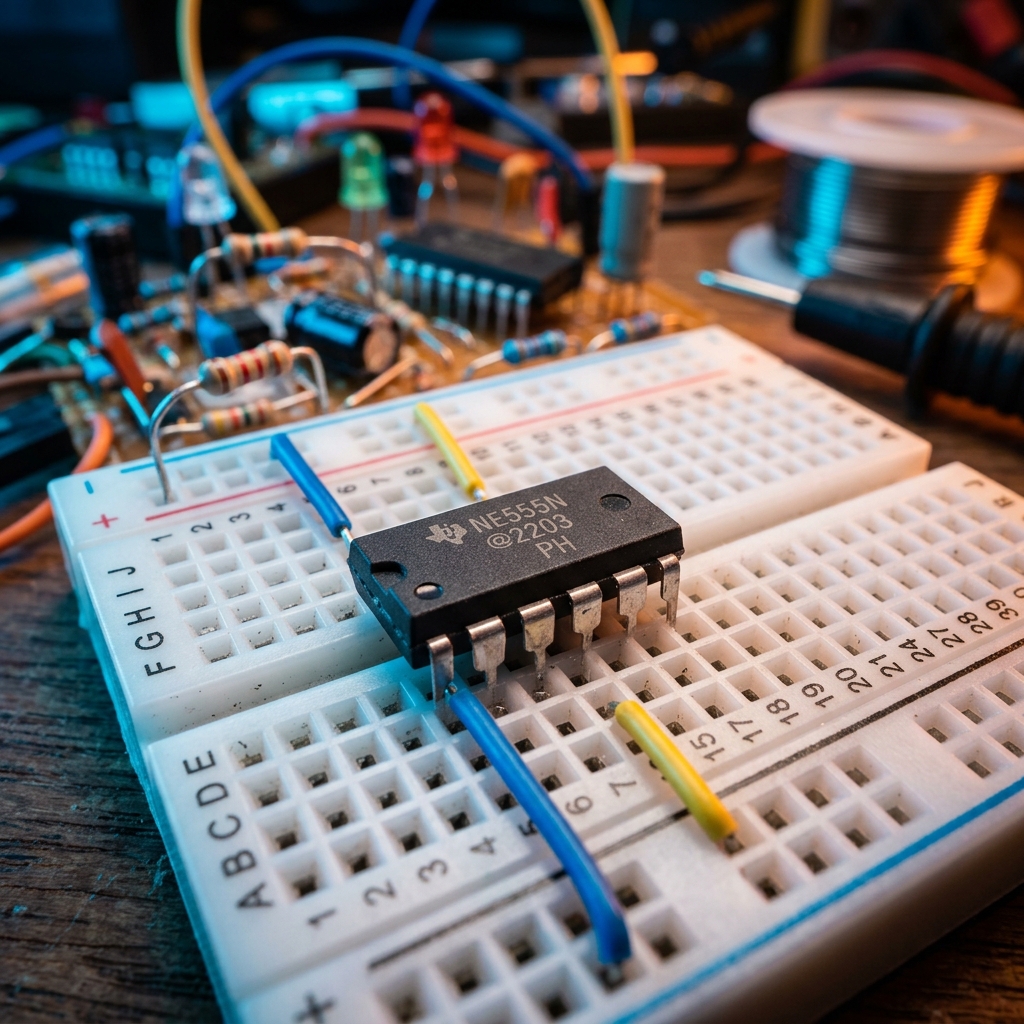
The Industry Workhorse
Since its inception in 1971, the 555 timer IC has become the most widely manufactured and beloved integrated circuit in history. Its popularity stems from its incredible versatility—it can function as an oscillator, a delay timer, a flip-flop, or a pulse generator.
Astable Mode: The Oscillator
When wired in Astable Mode, the 555 timer continuously triggers itself, creating an unending stream of square wave pulses. This is commonly used to blink LEDs, generate clock pulses for digital logic chips, or produce audio tones for simple synthesizers. The frequency and duty cycle of the output are controlled by just two resistors and one capacitor.
Monostable Mode: The One-Shot Timer
In Monostable Mode, the 555 timer requires an external trigger to activate. Once triggered, it turns its output HIGH for a specific amount of time before dropping back to LOW and waiting for the next trigger.
Real World Application: The 20-Second Delay-Off Timer
Monostable mode is perfect for creating hardware delay circuits. For example, imagine you are building a cooling fan controller for a 3D printer or amplifier. You want the fan to stay on for an additional 20 seconds after the main power switch is turned off to ensure the device is completely cooled down. By feeding the power switch state into the trigger pin of a 555 timer, and selecting the correct resistor and capacitor values, you can generate a precise 20-second 'delay-off' pulse. This pulse drives a relay or MOSFET that keeps the load powered exactly as long as needed!