Op-Amps and Their Use Cases: A Guide for Beginners
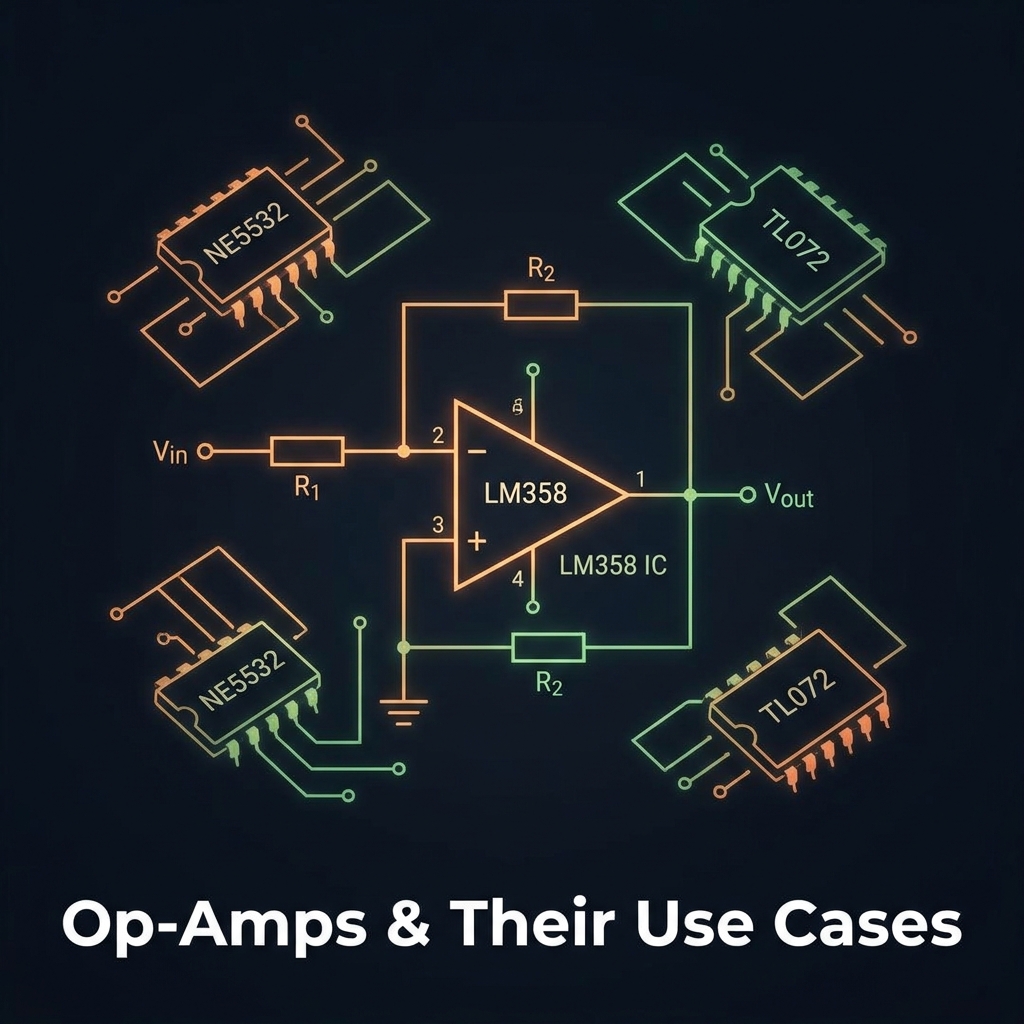
Introduction to Operational Amplifiers
Operational Amplifiers (Op-Amps) are the workhorses of analog electronics. They are highly versatile integrated circuits that can perform mathematical operations, amplify signals, filter noise, and serve as buffers.
Common Op-Amp ICs
- LM358: A very common, cheap dual op-amp. It's not a rail-to-rail op-amp but is excellent for basic, low-frequency tasks and DC applications.
- NE5532: Known for low noise, making it the industry standard for high-fidelity audio equipment.
- TL072: Features JFET inputs, giving it extremely high input impedance and low bias current, ideal for sensor interfacing and guitar pedals.
Key Configurations
1. Inverting Amplifier
The signal is applied to the inverting (-) input. The output is 180 degrees out of phase with the input. Gain is set by the ratio of the feedback resistor (Rf) to the input resistor (Rin): Gain = -Rf / Rin.
2. Non-Inverting Amplifier
The signal is applied to the non-inverting (+) input, while the feedback resistor network connects to the inverting input. The output is in phase with the input. Gain = 1 + (Rf / R1).
3. Voltage Follower (Buffer)
A special case of the non-inverting amplifier where the output is tied directly to the inverting input (Gain = 1). It has very high input impedance and low output impedance, used to isolate stages from loading effects.
Use the DevtronTech Op-Amp Gain Calculator to quickly find your required resistor values!