Protocol Deep Dive: I2C vs. SPI vs. UART for Embedded Engineers
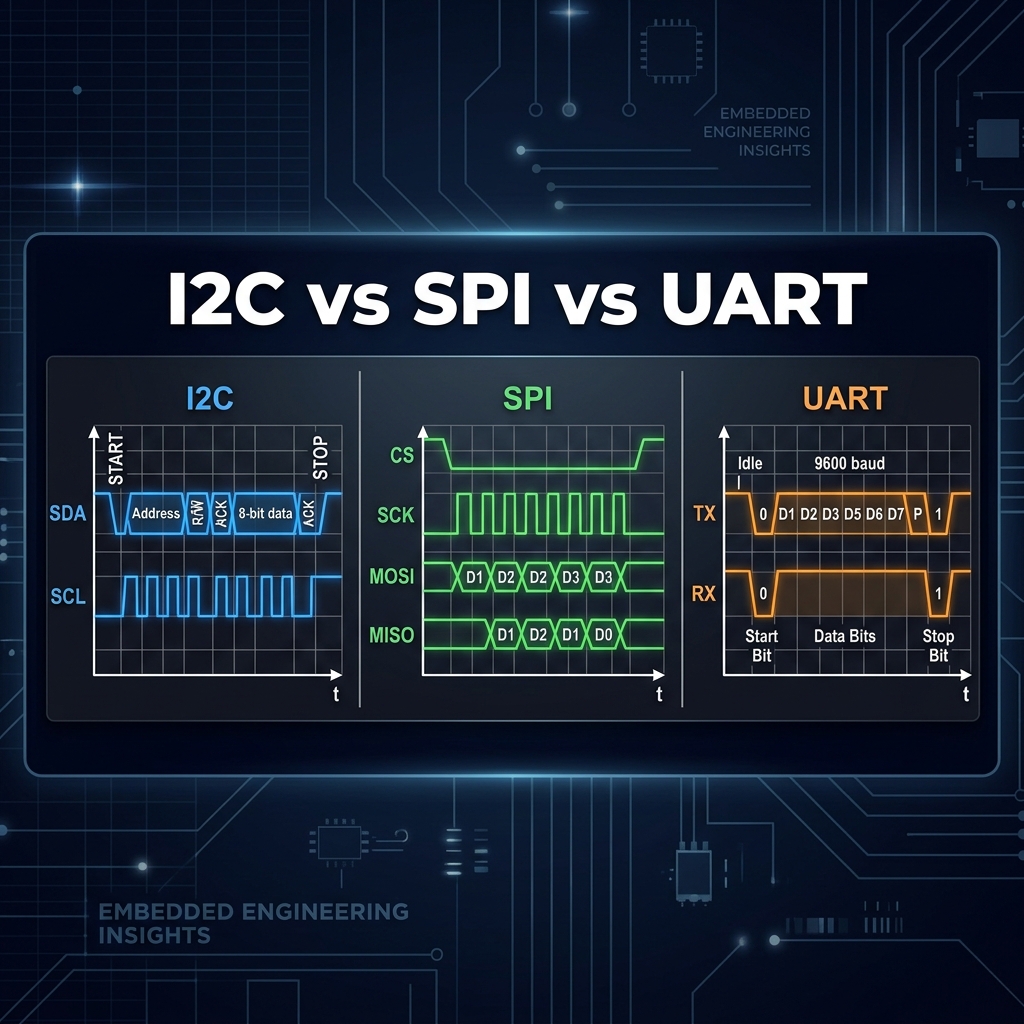
Choosing the Right Serial Protocol
Embedded systems rely heavily on serial communication to talk to sensors, memory, and other microcontrollers. The big three are UART, I2C, and SPI. Knowing when to use which is crucial.
1. UART (Universal Asynchronous Receiver-Transmitter)
Wires: 2 (TX, RX) + Ground
Speed: Low to Medium (typically up to 1-3 Mbps)
UART is asynchronous, meaning there is no shared clock signal. Both devices must agree on a baud rate beforehand. It is point-to-point (one to one). It's incredibly simple and robust, making it the standard for debug consoles and long-distance serial links (like RS-232/RS-485).
2. I2C (Inter-Integrated Circuit)
Wires: 2 (SDA, SCL) + Ground
Speed: Low to Medium (100 kHz, 400 kHz, up to 3.4 Mbps in high-speed mode)
I2C uses a multi-master, multi-slave architecture. A master generates the clock (SCL) and addresses specific slaves using a 7-bit address. Because it requires pull-up resistors and relies on open-drain pins, its speed is limited by capacitance. It is perfect for connecting multiple low-speed sensors on the same board without using up all your MCU pins.
3. SPI (Serial Peripheral Interface)
Wires: 4 (MOSI, MISO, SCK, CS) + Ground
Speed: High (often 10s of Mbps)
SPI is synchronous and uses dedicated lines for sending and receiving data simultaneously (full-duplex). There is no addressing overhead; the master selects a slave by pulling its specific Chip Select (CS) line low. It is fast and efficient, making it the go-to protocol for SD cards, displays, and high-speed ADCs.