Temperature Monitoring Options for XC7A100T FPGA
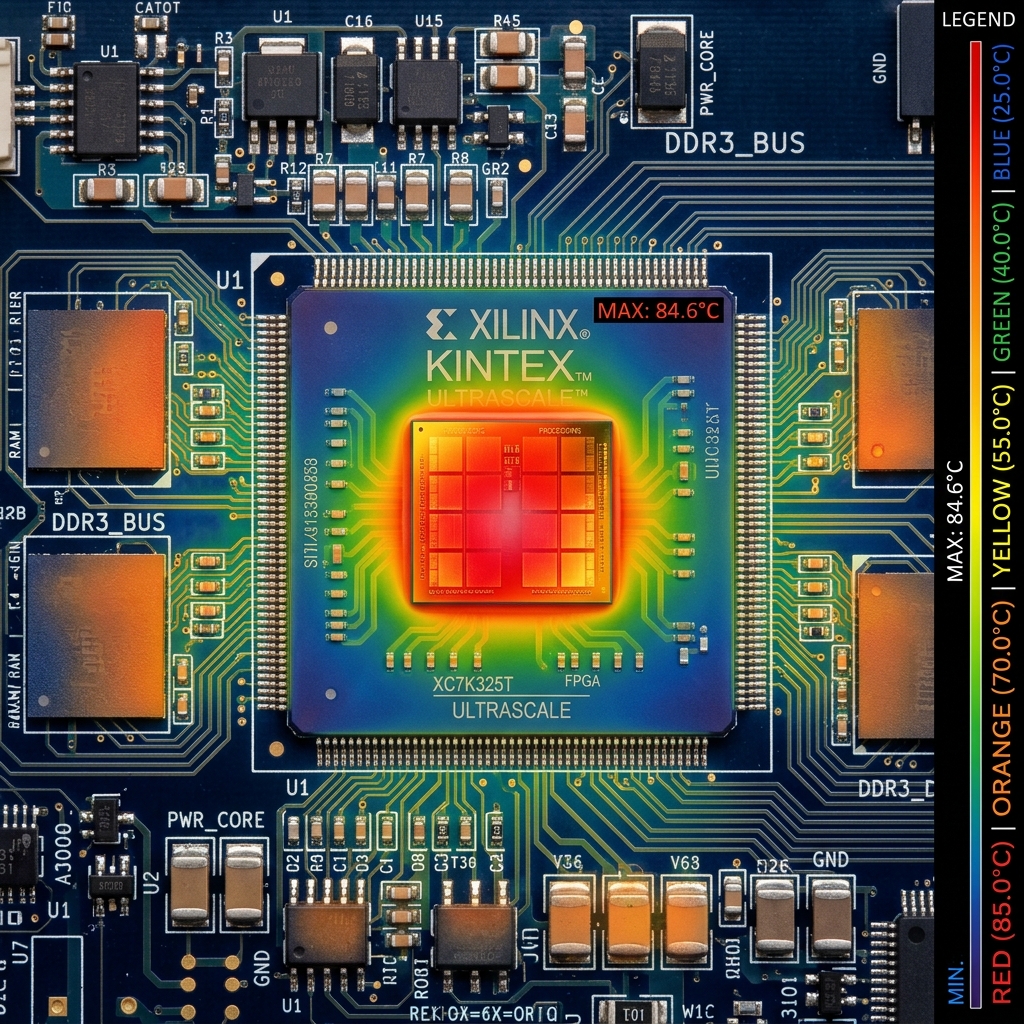
Temperature Monitoring Options for XC7A100T FPGA
When designing with the Xilinx Artix-7 XC7A100T FPGA (and similar ICs), temperature monitoring is critical for thermal management, ensuring system reliability, and preventing thermal damage. There are two primary methods for monitoring the die temperature of this FPGA:
1. Internal XADC (System Monitor)
The Artix-7 family features an integrated dual 1 MSPS, 12-bit Analog-to-Digital Converter (XADC) block.
- How it works: The XADC includes a dedicated on-chip temperature sensor located directly on the silicon die. It continuously measures the core die temperature and digitizes the readings.
- Usage: This temperature data can be accessed internally by the FPGA's own logic (e.g., via the DRP - Dynamic Reconfiguration Port) or accessed externally via the JTAG interface.
- Advantages: It requires zero external components, simplifying the PCB design and reducing the Bill of Materials (BOM). It also allows the FPGA to proactively monitor its own thermal state and trigger internal logic, such as alarms or throttling, if temperatures rise too high.
2. External Thermal Diode (DXP/DXN Pins)
The FPGA also exposes a direct connection to a physical PN junction (a thermal diode) fabricated on the die via the DXP (Diode Excite Positive / Anode) and DXN (Diode Excite Negative / Cathode) pins.
- How it works: An external hardware temperature monitoring IC (such as those made by TI, Maxim, or Analog Devices) connects to these pins. The external IC injects two precise, differing currents into the diode and measures the varying forward voltage drops. The voltage difference is used to calculate a highly accurate temperature reading.
- Usage: This is typically used when the system architecture requires a central, external hardware monitor or BMC (Baseboard Management Controller) to manage the thermals of all critical components (CPU, GPU, FPGA, etc.) independently.
- Advantages: Provides true "out-of-band" temperature monitoring. The external IC can read the FPGA's temperature and spin up cooling fans or cut system power even if the FPGA's internal logic is not yet configured, is held in reset, or has locked up.
- Unused State: If external monitoring is not utilized in the design, Xilinx documentation recommends tying both the DXP and DXN pins directly to ground (GND). This prevents the unconnected pins from acting as antennas and injecting electrical noise into the substrate.
Summary
- Choose the XADC for self-contained, internal temperature monitoring without additional component cost.
- Choose the DXP/DXN thermal diode pins when relying on an external, system-level management IC for board-wide thermal control and out-of-band monitoring.